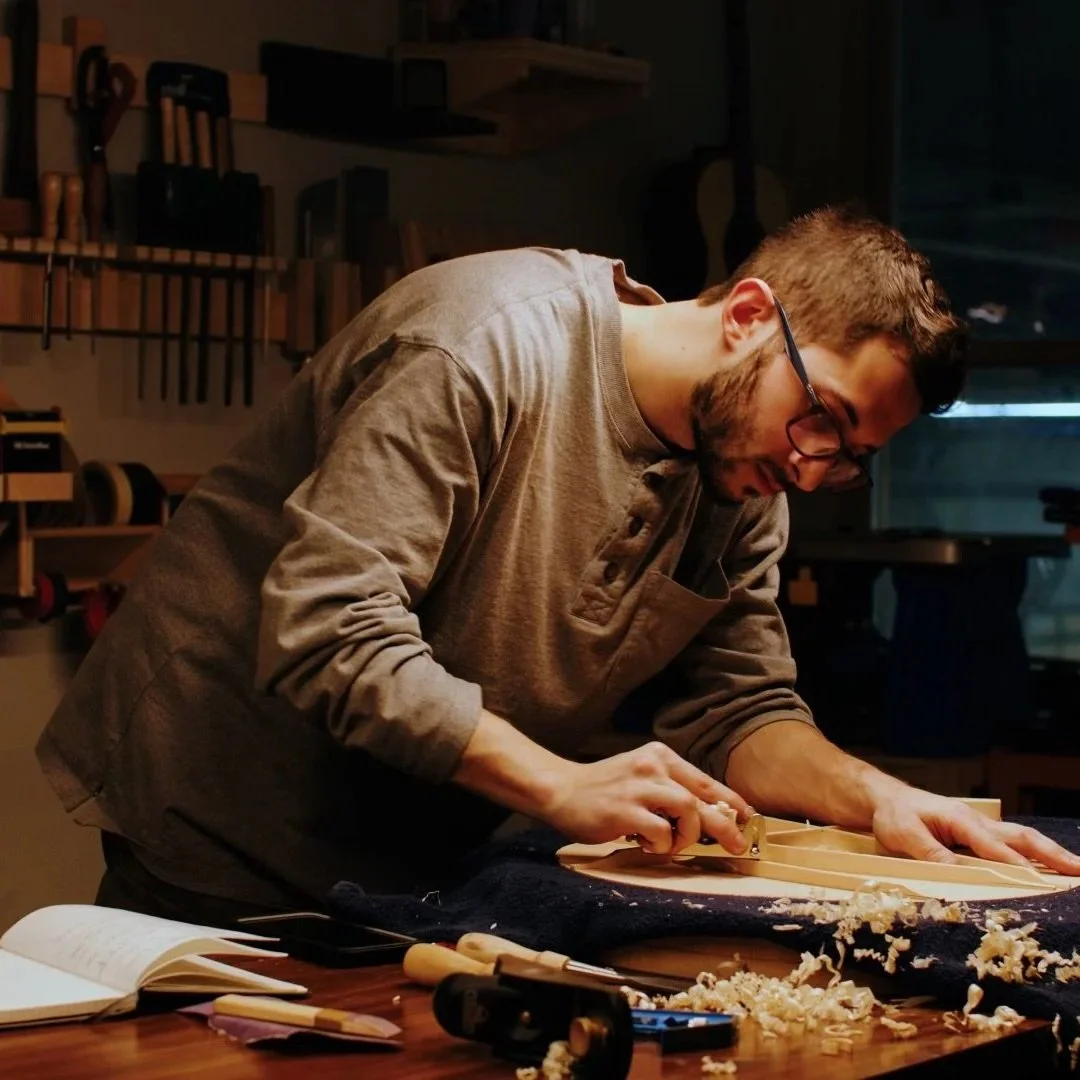
What would they do?
Many builders today are going to great lengths to preserve and replicate traditional steel-string acoustic guitars. These efforts have provided so much great insight, and the people who have committed their lives in this way are national treasures. But for me personally, I'm captured by the effort to push the guitar forward, leaning on the lessons of the past but reaching for the guitar of the future.
As a repair person in Nashville, TN, I occasionally get the opportunity to work on some very special vintage instruments. In those moments I try to learn what I can, but mostly, I think of the people who originally built and designed them.
My thought is this: if they had the technology, the data, and wealth of information we have today, they would use it. The musical context of the guitar has changed wildly over time. It has proven to be one of the most versatile and adaptable instruments in western music. In light of that, guitars contend with a new set of problems in the modern day. The context of the guitar has changed, and todays creation technology and access to information has reshaped the possibility curve for makers. If we could reach back into the late 1930s and pull a golden era master luthier into the modern day, I believe they would see room for improvement.

Details MAtter
If you are going to do all that, why not take it a step further?
Honestly, it does not matter how you do it—building a guitar is a lot of work. As a one-man shop, it seems to me that any detail that feels like a push in a positive direction is worth doing, no matter how much extra work it takes. I'm already going to unreasonable lengths just to construct the guitar; why stop short of giving it everything I've got?
After all, that is what feels good.
I think this way of thinking is much bigger than guitars. From my perspective, this is a pure expression of the human spirit. I see instrument makers as artists. I also see a 6-cylinder engine as art, so maybe my definition is a bit loose. However, I think we can all appreciate that the creation of musical instruments is an expression of raw human spirit.
I digress. The point is this: it feels good to step away from a project knowing I gave it everything I had. Strangely, that good feeling never seems to go away either. It may be silly, but I think the effort, time, and love work their way into the wood. Some guitars are haunted.
They could be haunted by the people who built them or the people who played them, but there's something left behind after lots and lots of raw effort that stays with the guitar forever.
Details make the difference. Always have and always will.
I don't hold back on the details. That does not mean I'm interested in covering the guitar in pearl or an exotic hardwood inlay of your dog. However, aesthetic detailing can provide a great deal of inspiration. Nature helps us with that by providing some pretty remarkable building materials, and generally I just try to emphasize that.
Instead, I mean that I consider every aspect of the build in great detail. It just feels good to do so, and that's the only reason I need. I enjoy the minutiae of guitar tone and the physics of sound. What glue will I use for this joint and why? How can I reduce the weight of this part? Where does the dominant mode of this top fall in relation to the musical scale? Could this be stiffer? Should it be? And my personal favorite: "What happens when I do this?"
I can't leave out the significance of a detail falling short. That just sucks. Personally, I find it hard to look at anything the same way after I've discovered a detail that bugs me. With a guitar, it does not take much. Sharp fret ends, for example—that's a total bust. In fact, the setup is probably the single most important set of details to do with the whole instrument.
If the guitar is stunning but plays like a dog, well, it's a beautiful piece of woodworking, but not a complete instrument. When I go to bed at night, I sometimes lie awake thinking about fret buzz, and that's the way I think it ought to be. Details make the difference, and I learn a ton from my clients on that part as well. A great player's hands can measure detail like an electron microscope. I know that and respect it.
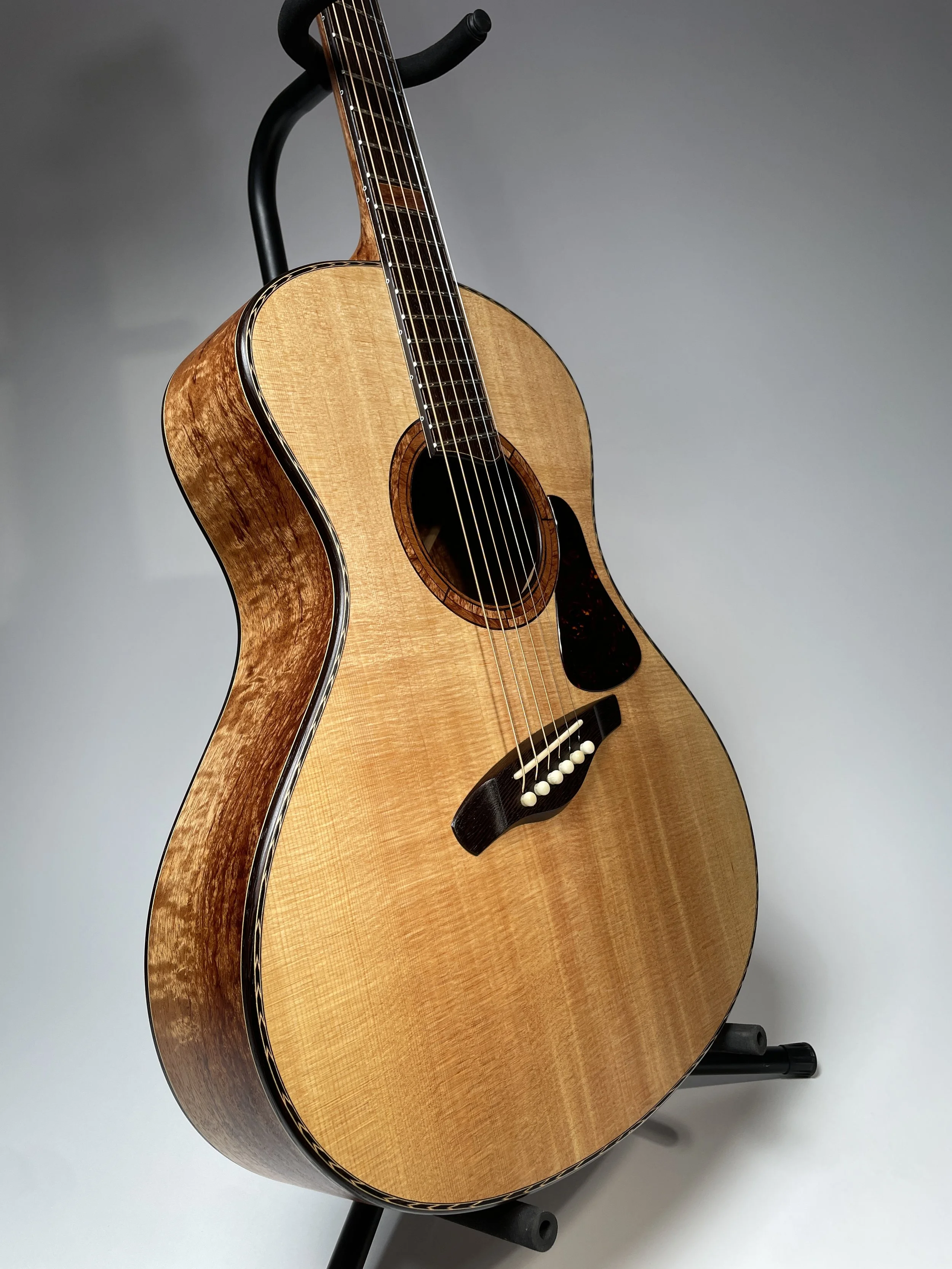
I do this for me
My focus is on building the best instrument I am capable of. This is as much a pursuit of personal development as it is an effort to create a great product. It may be unhealthy, but my identity is all mixed up in what I do for a living.
I simply want to live a life that feels good.
Nothing helps me with that more, than total commitment to crafting these instruments at the highest level I can, and connecting with the musicians, enthusiasts, and builders who share my appreciation for the guitar.
Guitar Repair is guitar reaserch
Some of the most formative learning experiences that now inform my guitar building were learned during a repair. Taking the opportunity to rescue an instrument from the dead can really shed some light on the things that count in the long run. Make a habit of taking on that kind of project like I have and, you might start to notice some patterns.
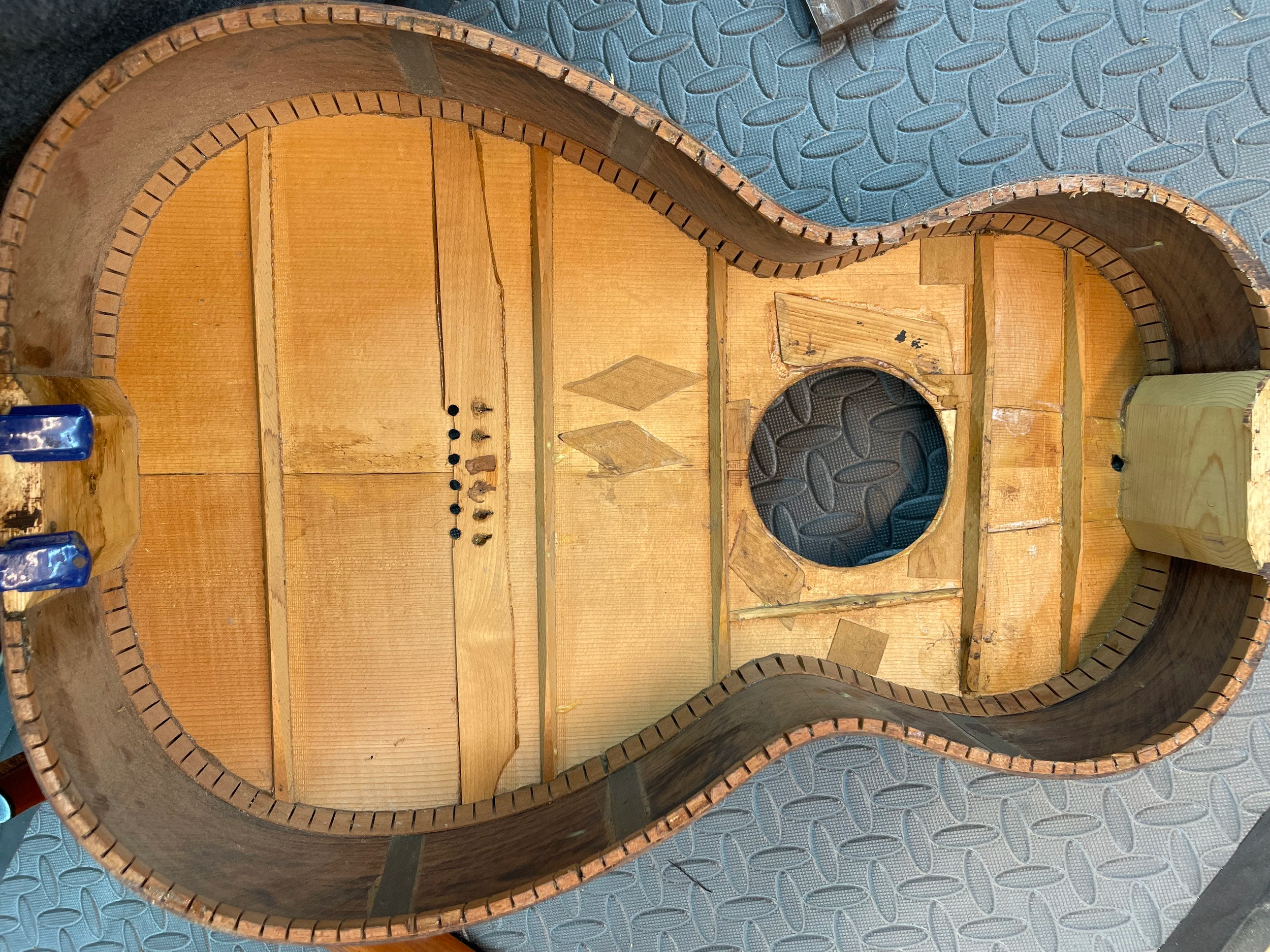
It’s going to get worse before it gets better.
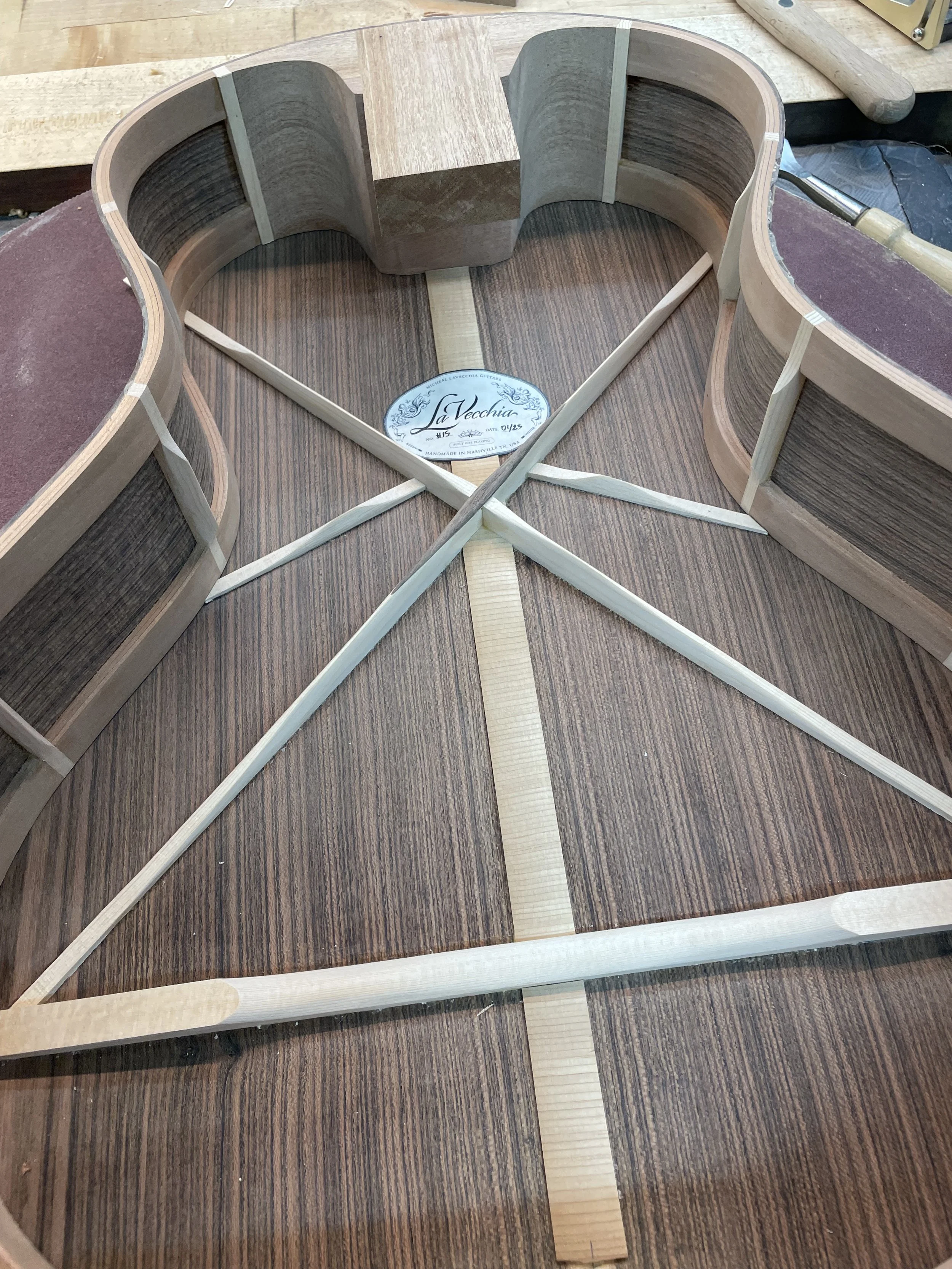
The last time someone saw this Bay State Parlor acoustic from this perspective would have been right before they closed the box at the factory in 1896.
Some Lessons I’ve learned in repair
-
I believe in hot hide glue, not because of tradition but because of its serviceable properties. Hide joints can be rehydrated, reheated, and cleanly disassembled. They can also be re-adhered without needing to remove the surface fibers of the glue joint, unlike most other options. These properties alone are highly desirable for wooden instruments which need serviceability if they are expected to last.
But the advantages do not simply end there. Hot hide glue by its nature needs to be applied hot and clamped before it cools. While cooling, it contracts and creates an impressive amount of force in doing so. Mark Stutman from Folkway Music points out that hide glue was once used to etch glass because of this effect.
Once the glue is dry, it behaves uniquely compared to other options because it becomes hard like crystal. On the contrary, commonly used yellow glue or PVA (used for its convenience) always stays a bit rubbery and is engineered to do so.
All things considered, if I'm working so hard to source great material and build an effective acoustic system, why the heck would I want a rubbery layer holding all the parts together?
Now consider hot hide glue. With a small amount of extra effort, I can use an extremely strong and reliable glue that will pull the parts together through thermal contraction, in addition to clamps, and harden to a glass-like quality while also being easily repairable. The stuff is downright magical and perfect for a huge portion of the guitar parts.
However, I do not use hide glue on every part of the guitar. For example, to bind a synthetic material like carbon fiber to wood, a resin-based adhesive is the proper tool for the job.
-
Wood needs some time to forget that it was once a tree. If you've never thought about this, it's not a silly notion to ignore. A tree has all sorts of stress on it as it grows depending on its environment. A tree that is exposed to high wind shear will grow in such a way that it can resist that wind shear. When that tree is eventually cut into lumber, it will be sawn up into straight boards, and each one of those boards will have internal stresses as a result of being separated from the balance of forces in the log.
It's common woodworking knowledge that wood must be dried before it's used and may warp during this process due to these internal forces. However, the drying process does not completely eliminate the stresses, and simply cutting a board in half can release internal forces again even when dry and create another opportunity for warping.
This is why material selection is critical, and beyond the quality of the material, the manner in which it was prepared has a significant impact on the stability of the instrument. More affordable guitars often fall victim to this. At their price point, wood selection is a non-factor and is often not suitably dry.
A dual-way truss rod does not stand a chance against a neck that wants to bow. If the stresses are there, they will eventually win.
Humidity changes can make these stresses show like childhood traumas, and if the wood is not properly dried, the effect is worse. It's also very difficult to stop wood from cracking if it needs to shrink. With the thin woods in acoustic guitars, it's likely that cracks will appear in solid wood instruments that are not humidified.
Also, different species will absorb and release moisture at different rates, which can introduce new stresses and cause all sorts of funny geometry to appear as the wood finds a path of least resistance.
As a builder, I try to manage the possibilities with attentive wood cutting practices, intentional grain orientation, and a climate-controlled environment to build in.
Beyond just that, I believe in the power of thoughtful and informed construction techniques. A laminated guitar neck is constructed of many strips of wood instead of one board. When built properly, a laminated neck will have much smaller internal stress as each part is smaller than the whole. No one strip of wood can exertenough force to effect the whole, ideally arranged in a way that the forces mirror each-other balancing out and creating a very stable structure. The neck blank described essentially becomes an engineered material instead of just wood.
This is a somewhat endless topic, so I won't go on much longer here, but here's one more thing to consider. There is one brand of guitar that's built a reputation for a fairly fragile headstock design. This is entirely due to the way the neck is being cut from a single board. This "one-piece" construction style is commonly marketed as a feature, but in reality it's harmful in almost every aspect of the guitar's performance. Not to mention that it's a wasteful practice of a precious material.
-
I don't think there's a "correct" way for a guitar to feel, but I do believe that the way it feels will have the largest impact on tone. Love it or hate it, it's the way that you play that makes it speak. If the feel is off, you will never find that "plays itself" groove.
Feel is not just neck shape and string spacing. It's also intonation, neck relief, nut height, and saddle height. It's scale length and break angle and top stiffness and headroom. It's how the guitar reacts to being hit really hard and how it responds to the slightest touch. Feel is about the connection between the body and the instrument, and when the feel is right, everything is right.
The setup plays a much bigger role in one's instrument enjoyment than anything else. Adjusting bracing patterns and back and side woods adds colors and layers to the identity of an instrument, but setup and therefore feel is, to me, the most important aspect of any instrument. That presents a challenge—setup is subjective, personal preference is a big factor. I try to address my clients' setup needs individually.
I often find myself remembering a friend repeating a line from one of his teachers: "Your favorite guitar is probably whichever one currently has the best setup for you." I think a great musician can make almost anything serve, but I tend to believe that a better feel leads to a better instrument as a whole.

Thoughts and storys
-
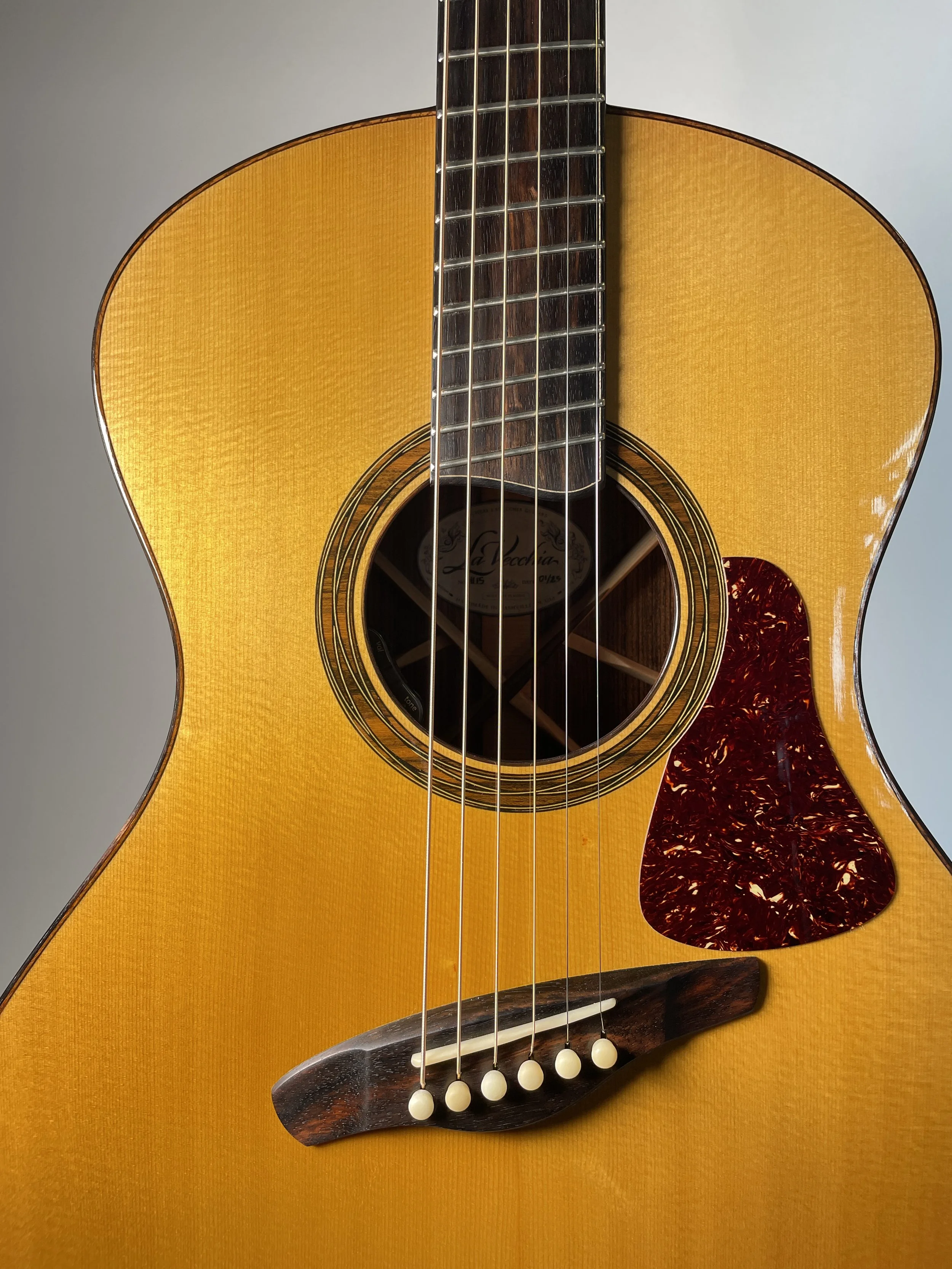
Why I Build Guiars
A short story about the moment my love and endless wonder for the guitar began.
-

Building Guitars With Soul
I don’t build perfect guitars, I build guitars with soul. Ever single one demands my attention, heart and full effort. No Two are the same, and when you pick it up, you can feel the love that goes into them, Read about my philosophy more by clicking the button below.
-
My Story So Far
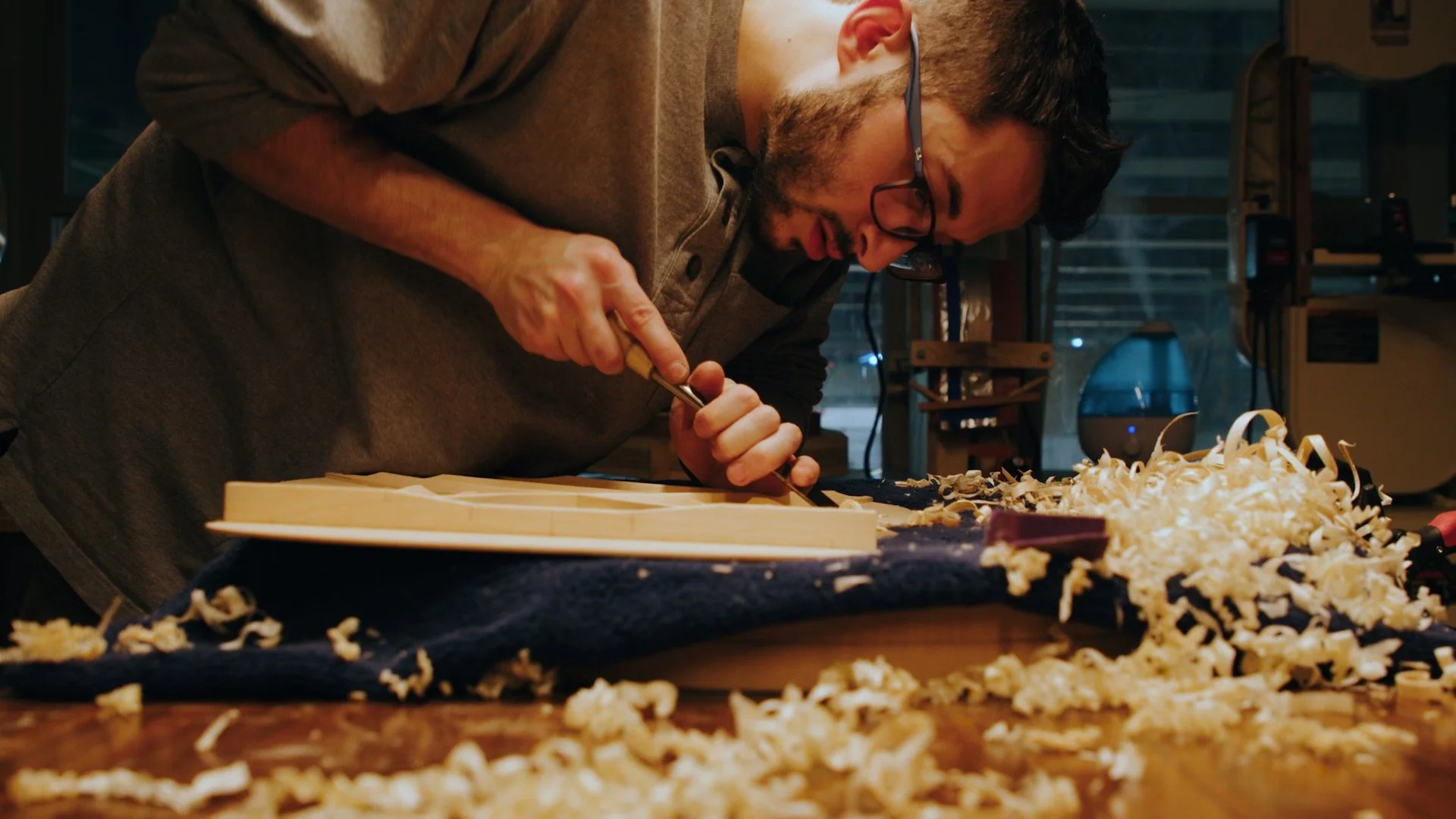
I started my business in 2023, But I have been dreaming of it and developing my skills for over 12 years. Its been an absolutely wild ride to get where I am today. Im very grateful, but also very excited to see where it all goes. Learn how Ive developed and where its all headed by clicking the button below.
-
Repair work and Its Influence on Building
In addition to my builds, I run a full service repair shop in Nashville TN. I use the lessons learned in each repair to inform my designs. You can read more about how repair influences my builds by clicking the button below.